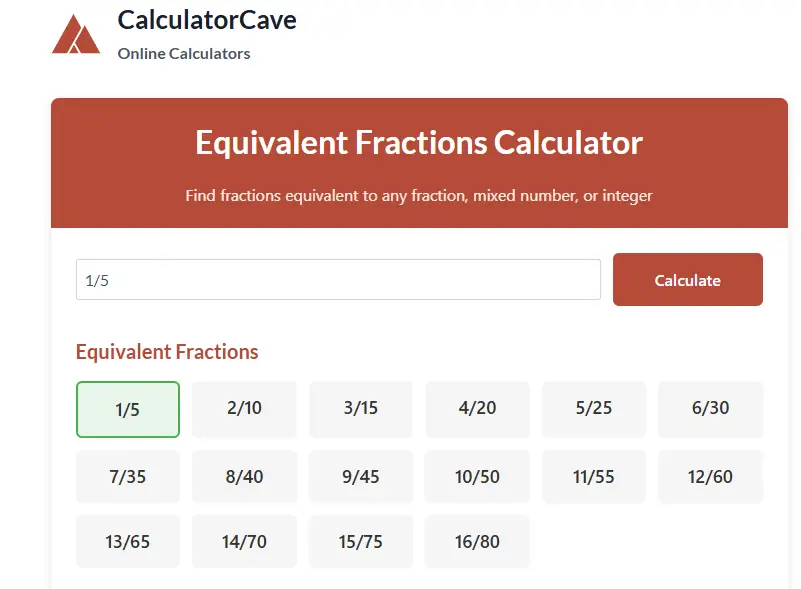
Equivalent Fractions Calculator
Find fractions equivalent to any fraction, mixed number, or integer
What are Equivalent Fractions?
Equivalent fractions are fractions with different numbers representing the same part of a whole. They have different numerators and denominators, but their fractional values are the same.
For example, 1/2 = 2/4 = 3/6. They represent the same portion of a whole even though the numbers are different.
How to Find Equivalent Fractions
Multiply both the numerator and denominator by the same whole number. This creates a new fraction with the same value.
| Calculation | Result |
|---|---|
| 1/2 × 2/2 | 2/4 |
| 1/2 × 3/3 | 3/6 |
| 1/2 × 4/4 | 4/8 |
Equivalent Fractions Calculator
The Equivalent Fractions Calculator helps you quickly find fractions that have different numerators and denominators but represent the same value. Whether you enter a simple fraction, a mixed number, or even a whole number, this tool instantly shows all equivalent forms. It’s perfect for students learning fractions, teachers preparing examples, or anyone brushing up on math fundamentals.
Explore more math tools on the Math Calculators page to make every calculation simple and accurate.
What Are Equivalent Fractions?
Equivalent fractions are different numerical representations of the same portion of a whole. Although their numerators and denominators differ, the ratio between them is identical.
For instance, the fraction 1/2 represents half of something. The same value can also be shown as 2/4, 3/6, or 50/100. Each of these fractions equals 0.5 in decimal form, meaning:
1/2 = 2/4 = 3/6 = 50/100
Equivalent fractions are especially useful when comparing, simplifying, or performing operations involving multiple fractions.
How to Find Equivalent Fractions
The rule is straightforward: multiply or divide both the numerator (top number) and the denominator (bottom number) by the same non-zero whole number. The value of the fraction remains unchanged.
Plain Text Formula:
Equivalent Fraction = (Numerator × n) / (Denominator × n)
Example:
Find fractions equivalent to 3/4.
3/4 × 2/2 = 6/8
3/4 × 3/3 = 9/12
3/4 × 4/4 = 12/16
3/4 × 5/5 = 15/20
All of these fractions—6/8, 9/12, 12/16, and 15/20—are equivalent to 3/4. Reducing any of them brings you back to the original 3/4.
If you need to verify calculations or perform quick arithmetic checks while learning about equivalent fractions, the Basic Calculator can help.
Why Equivalent Fractions Matter
Equivalent fractions simplify problem-solving across various math operations:
- Addition or subtraction: Aligning fractions to a common denominator.
- Comparison: Checking which fraction is larger or smaller.
- Simplification: Reducing fractions to their simplest form for clarity.
For example, comparing 2/3 and 4/6 becomes easy once you see that 4/6 simplifies to 2/3—they’re equal.
Equivalent fractions also appear frequently in financial and real-world scenarios, such as dividing profits, measuring ingredients, or analyzing ratios. To handle real-life financial calculations efficiently, you can use the Adding Machine Calculator.
Working With Mixed Numbers and Integers
You can also find equivalent fractions for mixed numbers and integers.
For example:
1 1/2 = 3/2 = 6/4 = 9/6
Similarly, an integer like 5 can be represented as:
5/1 = 10/2 = 15/3 = 20/4
This consistency shows how all numbers can be expressed as fractions, forming the foundation for more complex mathematical concepts like ratios, proportions, and algebraic fractions.
Simplifying Fractions to Check Equivalence
To verify whether two fractions are equivalent, simplify each to its lowest terms. Divide both the numerator and denominator by their greatest common factor (GCF) until they can’t be reduced further.
Plain Text Formula:
Simplified Fraction = (Numerator ÷ GCF) / (Denominator ÷ GCF)
Example:
Simplify 8/12.
GCF of 8 and 12 = 4
8 ÷ 4 = 2
12 ÷ 4 = 3
So, 8/12 = 2/3
To find the GCF easily, you can use the Common Factors Calculator.
Equivalent fractions are the cornerstone of understanding rational numbers. By multiplying or dividing both the numerator and denominator by the same number, you create fractions that look different but hold the same value.
Use the Equivalent Fractions Calculator to explore these relationships instantly, simplify your learning, and enhance your problem-solving accuracy. For more tools to strengthen your math skills, visit the Math Calculators collection on CalculatorCave.