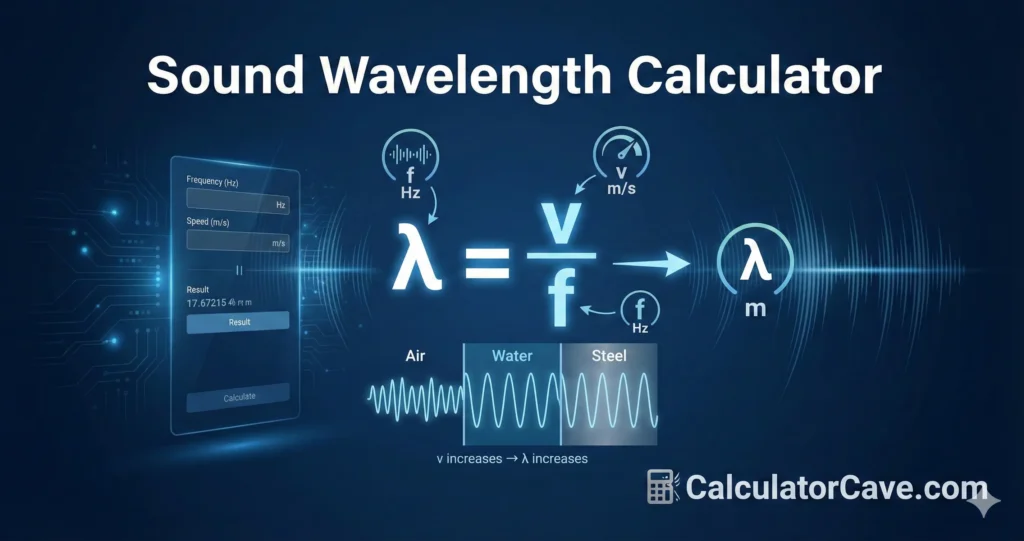
Sound Wavelength Calculator
Sound Wavelength Calculator — quickly compute wavelength from frequency and speed of sound using the formula λ = v / f.
How the Sound Wavelength Calculator Works (λ = v / f)
The relationship between sound wavelength, frequency, and speed is defined by the fundamental wave equation. This physics formula helps engineers, musicians, and students calculate the physical distance of one sound wave cycle.
The Formula
- λ (Lambda): Wavelength (meters)
- v (Velocity): Speed of Sound (meters per second)
- f (Frequency): Pitch (Hertz or cycles per second)
To use the Sound Wavelength Calculator, simply input the frequency of the sound. The tool automatically applies the speed of sound (defaulting to air at 20°C) to solve for λ. You can also use the calculator in reverse to find frequency if you know the wavelength.
Typical Speeds of Sound
Sound travels at different speeds depending on the density and temperature of the medium. Sound moves faster in solids (like steel) than in gases (like air). In air, temperature plays a major role: for every degree Celsius increase, speed increases by approximately 0.6 m/s.
| Medium | Condition | Speed (m/s) |
|---|---|---|
| Air | 0°C | 331.3 |
| Air | 20°C | 343.0 |
| Water | Fresh, 20°C | 1482 |
| Concrete | Solid | ~3600 |
| Steel | Solid | ~5960 |
Examples: Wavelengths across human hearing
The human ear can detect frequencies roughly between 20 Hz and 20,000 Hz. Low bass notes have massive wavelengths, while high-pitched sounds have wavelengths measuring just millimeters.
| Frequency | Description | Wavelength (Air, 20°C) |
|---|---|---|
| 20 Hz | Lowest audible bass | 17.15 m (56.3 ft) |
| 100 Hz | Punchy bass (Kick drum) | 3.43 m (11.2 ft) |
| 440 Hz | Concert A (Tuning) | 0.78 m (2.5 ft) |
| 1,000 Hz | Mid-range | 34.3 cm (13.5 in) |
| 10,000 Hz | High Treble | 3.4 cm (1.3 in) |
Frequently Asked Questions (FAQ)
A1: The wavelength (λ) is calculated by dividing speed (v) by frequency (f): λ = v / f.
A2: Typical speed at 20°C is about 343 m/s. Speed changes with temperature and medium.
A3: Yes — use f = v / λ.
A4: Speed of sound differs by medium, so for the same frequency, the wavelength changes proportionally to speed.
A5: Yes — in air, speed increases with temperature. The calculator can compute v from temperature using an approximate formula.
A6: The audio tool generates pure tones for demonstration. Users should set volume low; avoid prolonged loud exposure.
Related Internal Physics Calculators
If you’re exploring physics and wave behavior, you may also be interested in these calculators:
- Diopter Calculator
https://calculatorcave.com/calculators/physics/diopter-calculator/ - Earth Curvature Calculator
https://calculatorcave.com/calculators/physics/earth-curvature-calculator/ - Work Calculator
https://calculatorcave.com/calculators/physics/work/ - Angular Momentum Calculator
https://calculatorcave.com/calculators/physics/angular-momentum/ - Centripetal Force Calculator
https://calculatorcave.com/calculators/physics/centripetal-force-calculator/
These tools help reinforce core physical principles and are useful complements to sound wave studies.