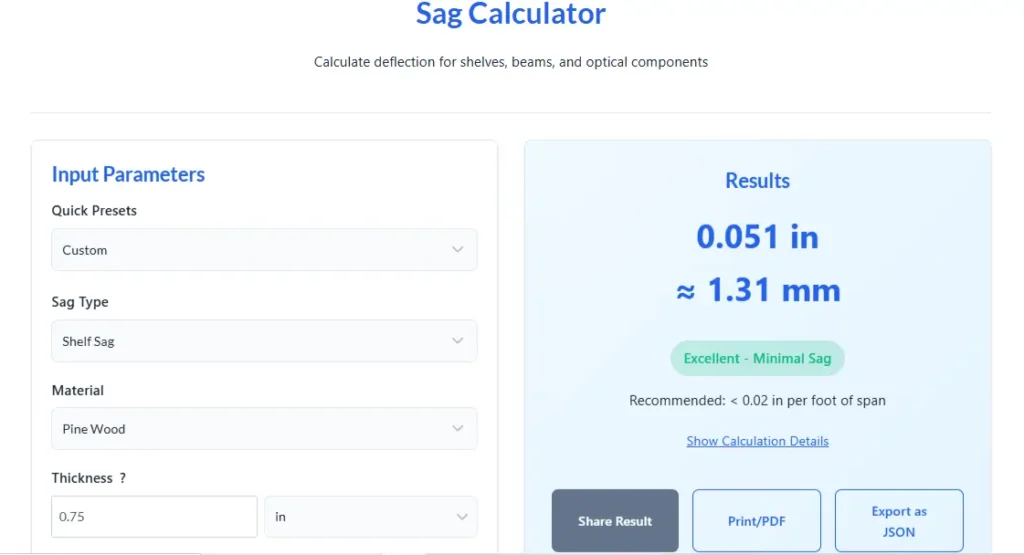
Sag Calculator
Calculate deflection for shelves, beams, and optical components
Input Parameters
Results
Enter values and click “Calculate Sag” to see results
Calculation Details
Formula Used: δ = (5 * w * L⁴) / (384 * E * I)
Where:
- δ = Deflection (sag)
- w = Uniform load per unit length
- L = Span length
- E = Modulus of Elasticity
- I = Moment of Inertia
Recent Calculations
What is Sag?
Sag, or deflection, is the degree to which a structural element bends under a load. In shelves and beams, excessive sag can lead to structural failure or visual imperfections. For optical components, even minimal sag can affect performance.
How to Reduce Shelf Sag
- Use thicker material or add support brackets
- Choose materials with higher stiffness (higher modulus of elasticity)
- Reduce the span between supports
- Distribute loads more evenly
- Add a front edge reinforcement
Frequently Asked Questions
For most applications, sag should be less than 1/360 of the span length. For shelves carrying heavy loads, aim for less than 1/720 of the span. For optical applications, requirements are much stricter.
Place a straightedge along the bottom of the shelf and measure the gap at the point of maximum deflection. Alternatively, use a string stretched taut between the endpoints and measure the gap at the center.
Common reasons include: incorrect material properties, higher than expected loads, moisture content changes in wood, improper support installation, or material defects.
You can use either imperial (inches, pounds) or metric (millimeters, kilograms) units. The calculator will automatically convert between systems and display results in both.